
This is an old revision of the document!
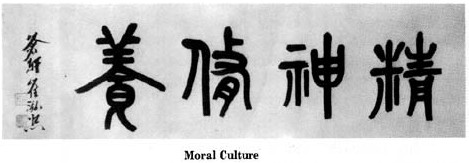
MORAL CULTURE
(Jungshin Sooyang)
The broad connotations and various possible interpretations of the moral culture are often very difficult for the western mind to grasp because this is an aspect of Oriental Philosophy which pervades the lives of Oriental people. In a word, it is the endeavor and process of becoming an exemplary person such as Confucius (552-479 B.C.1))
To become such a person, one has to first find himself and acquire a moral character which is respected by all. This can only be achieved through constant practice of mental discipline. Thus, if the times call for it, the mentally disciplined man can contribute to the building of an ideal society through wise counsel to the government and, even after death, through his everlasting examples.
Confucius said, “to promote the sense of morality one must treat others with faithfulness and sincerity based on righteousness, and to eliminate completely vicious thinking”.
Everyone of us, as a social being, desires to live in a free and peaceful society. At the same time, it is our obligation to build such society for the people.
I have quoted various words of wisdom of ancient saints and philosophers for creating an ideal society in the hope that students of Taekwon-Do use them as a guide to cultivating their moral culture.
An ideal society, according to LAO-TZU, is one in which the ruler is of such high moral character that he can rule naturally, not by interference or fear but by appealing to the good nature of his people, who by merely doing their duty can live freely in peace without fear and anxiety.
Next, a moral society is one in which the people admire and praise their ruler in gratitude for his love and the benign disposition he bears toward his people.
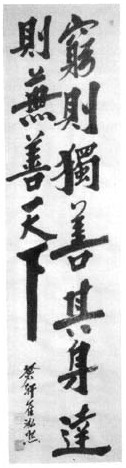
Thirdly there is a “legalistic society in which the ruler because he lacks the moral authority resorts to various laws to govern his people, who in turn obey because they fear the retribution that the violation of these laws will bring. Under these circumstances, the ruler loses close touch with his people.
Finally the worst kind of society is that in which the ruler, through deception and trickery, misuses his legal authority to further his personal ambitions and imposes his rule upon his people by force as he deems necessary. In such a society, the ruler is despised and hated by his people and eventually invites not only his own downfall but with him the downfall of the people and the country.
In Taekwon-Do a heavy emphasis is placed on moral culture, for it not only promotes a healthy body and keen mind but good sportsmanship and the perfection of moral behavior. As ancient Greeks first espoused in their sound mind, sound body, creative spirit concept, the more disciplined and cultivated the mind is, the more disciplined and cultivated will be the student's use of Taekwon-Do.
No doubt the following lessons may be somewhat hard to fully understand; however, it would behove the serious student of Taekwon-Do to read, digest, and attempt to grasp these very fundamental essences of moral culture.
A. Return to the basic nature—Mencius gave the following analogy when he reasoned that a man is basically good.
Even a ruthless robber, coming upon an innocent child about to fall into a well, will try to save the child, forgetting for the moment, his intention to rob the house. This good nature becomes obscured or completely lost by greed for money and power.
B. Be virtuous—It is difficult to define what virtue is. However, these are five human qualities which have been recognized as virtues since ancient times; humanity, righteousness, courtesy, wisdom, and trust. To be virtuous one must constantly cultivate and practice these virtues.
Confucius said
“Virtue is like the north star. All the stars revolve around it in an orderly fashion.”
Therefore, people who surround the virtuous person, naturally will act for the betterment of society.
1, HUMANITY (IN)
The ability2) to feel sorrow for the misfortunes of fellow men and love them all equally as parents love their children equally.
Confucius defined humanity in the following ways:
- A. To love people, especially one's parents.
- B. Not asking others to do what you would rather not do.
- D. To have unbending desire to accomplish what is right regardless of how insignificant the result may initially seem when compared to the amount of effort put forth.
- E, To value others' honour before your own.
- F. To put others' freedom before your own.
To implement humanity he said one should:
- 1) Practice utmost prudence, modesty and discretion in everyday life.
- 2) Devote oneself to assigned work be it large or small.
- 3) Demonstrate sincerity with whole heartedness to others at all times.
Tae Kong Mang (12th century B.C.) said;
“The heaven provides four seasons while the earth has the power to produce all living things. This privilege is not reserved for any specific person but for all human beings… Therefore, humanity lies in the idea of sharing the fruits of nature with all people.”

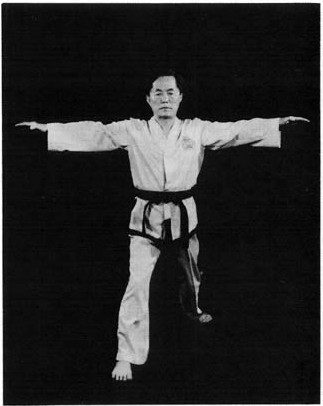
2. RIGHTEOUSNESS (UI)
The ability to feel ashamed of unjust acts and to do one's duty to others.
Mencius said; “for the ordinary person life and death are the most important in the life. However, for the virtuous person to live and die for righteousness is far more important than life and death themselves.”
Righteousness is well defined in the act of a certain army general depicted in the book of “War Manual” written about 2,400 years ago.
A General was taking a break from the gruelling war with his soldiers by a river bank when an aide brought him a small carafe of wine for his refreshment. He took the carafe and slowly emptied it into the flowing river in full view of the puzzled soldiers and invited them to share the wine with him by taking a sip of the water from the river.
5) As to righteousness; Manfucius claimed it to be the fundamental virtue to be observed by a human being. According to Sooja, “It is the essential element along with the propriety (Ye) for moral education.” Confucius said, “It is the supportive measure employed to enhance humanity thought to be the highest degree of virtue.”
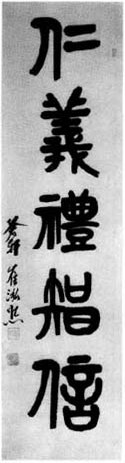
3. PROPRIETY (YE)
Unlike animals fighting over food, a courteous man would offer another man a piece of bread even though both were starving, out of respect and good manners.
Confucius said, “Propriety must be practised for the proper development of personality, and whoever lacks sincerity in his words, cannot be considered a gentleman.”
He also said
- “Honesty without courtesy can be rather ruthless.”6)
- “Respectfulness without courtesy can make the recipient rather uncomfortable.”
- “Courageousness without courtesy can be rather violent.”
- 7)“Prudence without courtesy can be rather cowardish.”
Ye is a term describing proper code of conduct between various social status, for example: superior and inferior, noble and common, old and young, rich and poor, etc.
4, WISDOM (JI)
The ability to judge right from wrong, not especially in matters concerning the right and wrong of others but in matters concerning oneself.
A wise man (Yu Bee) once said to his sons, “no matter how small it is you should not do what you realize is wrong. On the other hand you must do what is right no matter how small it may seem.”
5. TRUST (SHIN)
The ability to keep one's words and promises, not only to one's friends but to everyone in general. Without trust a person loses all principles and dignities and becomes a liar and a cheater.
| II |
How, then, can man discover his own human nature?
There are two ways by which a person can find himself: first, by preserving the goodness given to him by God or heaven at birth, and secondly by renouncing greed for material things.
A. Man may occupy two positions in a life time
Basically there are two kinds of position; one is the five virtues given by heaven, explained earlier, and the other given by man, such as a cabinet minister, bureau chief, and so on.
Unfortunately man often relies too much on worldly position which is transient at best, for what man gives can also be taken away. On the other hand, what heaven endows us with is eternal. This is not to say that we reject all worldly things but rather that we keep both positions in proper balance so that the virtues of the former position provides guidance for the proper use of the latter.
In this manner a man will gain respect and set good examples for others to follow. Without proper guidance, a person can easily fall victim to the temptations of personal power and wealth, employing unethical means to further his ambitions. Ultimately such a person will become a tyrant, or a dictator and an enemy of the people.
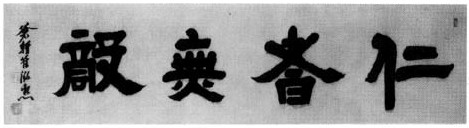
According to Confucius, a generous and loving man cannot have enemies. Therefore, humanity, the first virtue, is like a strong secure fortress.
B. Greed is insatiable
He who is content with what he has is the richest man in the world. On the other hand, if one has everything and still more, he may yet be poor. A man who is blinded by greed is not only given to corruption, intrigue and exploitation of others, but worst of all, he casts himself in the position of “friend fighting against friend, father fighting against son,” finally becoming no better than an animal.
There is certain truth in the old saying that a truly good person cannot be rich, and rich person cannot be a truly good person.
According to an ancient adage, “constant material dissatisfaction is considered to be the root of all misfortunes.” There is no better way to self satisfaction and human growth than the constant development of a generous nature.
C. Be humble
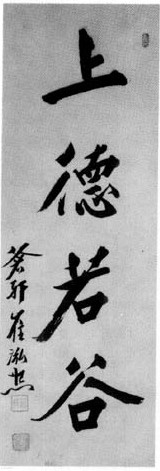 A weed holds up its head in arrogance while a mature grain bows its head in humility. Lao-Tzu taught that lofty virtue is like a deep valley into which all streams of water flow. A virtuous man will draw the respect of others toward him in the same fashion while one who is selfish and egoistic will loose the respect of his fellow man
and become despised and isolated.
A weed holds up its head in arrogance while a mature grain bows its head in humility. Lao-Tzu taught that lofty virtue is like a deep valley into which all streams of water flow. A virtuous man will draw the respect of others toward him in the same fashion while one who is selfish and egoistic will loose the respect of his fellow man
and become despised and isolated.
To be humble is not to engage in petty squabbles, but to be like the magnamous river in the low valley which irrigates the farm fields around it.
D. Self-criticism
No one is wise from the moment of birth. As human beings we have many faults and are prone to make mistakes. However, once having acquired knowledge we learn to correct these shortcomings.
It would not be impossible to eventually become8) perfect human beings. For this purpose, it is essential not be idyllic towards learning and continue to be willing to criticize oneself.
It is said that Confucius and his pupils practised self-criticism by repeating the following three times daily:
- Have I neglected others' requests because of selfishness
- Have I behaved with a sincere attitude towards friends
- Have I inspired others with certainty, while being uncertain myself
- Have I neglected to practise virtue
- Have I errored in my studies
- Have I avoided acting with righteousness
- Have I corrected myself immediately upon realising my fault
E. Be soft
Because light is formless and soft, it can illuminate and give warmth to even hidden corners. As water can assume any shape or form, it can better serve the living things that need it to survive. Once water becomes a part of the Ocean, even the largest ship is like a mere leaf, and its awesome fury when aroused can conquer the tallest mountain.
If one claims to be strong, he will soon meet someone who is stronger. A tree, such as sapling, can withstand a strong wind when it is soft and flexible but may be toppled or broken after it becomes old and brittle. The same principle also applies to human beings.
F. Respect of elders
As son respects parents, younger brother respects older brother, man must always respect his elders or seniors. This is the beauty of mankind, and one of the distinctions between human and animal
Mencius said there are three things of value in human society; position, age9) and moral integrity. In government, position is considered important, in a community, age10), and for a leader or advisor, moral integrity. Indeed, there can be no children without parents, nor a young generation without the old generation. A society and a nation could not avoid chaos without its culture and social order being based on respect for the knowledge and the wisdom of its elders.
G. Respect the rights of others
To criticize someone who is better, to covet other's possessions and to steal the merits of others are the marks of an unscrupulous man. Mother nature does make claims to her domain, yet all creatures within it acknowledge her eternal accomplishments. To help others develop and succeed in life is a reward in itself and has a true value only if nothing is expected in return.
Throughout human history, people who in jealousy have stolen the recognition due to others and have stolen their possessions out of avarice have always left dark imprints of shame and dishonor.
H. Be just
To be correct and forthright is to live one's life correctly. Old sages used to say; “To common men, life is most valuable, and death, most fearful.” However, a righteous man would value justice above life itself and would be willing to die rather than submit to injustice. Such notable figures as Baek-E-Sook-Je of China, Sung-Sam-Moon of Korea and Yoshida-Shoing of Japan all chose death in defiance of injustice, leaving to their posterity lasting examples.
Baek-E-Sook-Je lived in Chou period about 2,000 B.C. When King Moo toppled the twenty seventh King, who was a very notorious tyrant, he refused to serve the new King, who usurped the throne by force and not by legitimate process; he eventually starved to death in a self-imposed exile in the Sooyang mountains
Sung-Sam-Moon was an important minister of the King Se Jong, inventer of Han-Gul (Korean alphabet) in the 14th century. After the king died and the young Dan Jong became king his uncle Se-Jo conspired against the boy king and took over the throne. Minister Sung was later executed because of his persistent protest over the unlawful act of King Se-Jo. Yoshida-Shoing, one of the loyalists was also executed in protest when the Doku-Kawa military government, at the time, tried to abolish the Mei-Ji monarchy.
I. Be frugal
Since ancient times, excessive luxury and pleasure caused the downfall of many kings and nations without exception and history is full of such examples. Persons in leadership in particular must learn to be frugal and live moderately. As the old adage goes “if the water is muddy upstream so it will be downstream.”
An extravagant leader will affect his subordinates in this same way and will bring more hardship to his subjects through increased taxation and bribery. During the Lee Dynasty of Korea, the king's roving inspector, Lee-Mong- Yong, while travelling11) the countryside incognito, was invited to one of the lavish dinner parties of a notorious governor. In the middle of the feast, he recited his famous poem:
//The sweet wine you drink from the glittering cups//
//Flows from the tears of people who toil//
//The tender meat which fills the dishes of jades is torn from their aching flesh//
//Merrier you laugh, sadder they will weep//
//Louder you sing, more plaintive their lament.//
The governor and his cohorts recognizing the true identity of the poet, became frightened and fled from the scene. Remember that there are tears and heartaches of many behind one man's pleasure.
J. Be discreet
In every thing he does, a person must not be impulsive or reckless but be patient and thoughtful. “He who acts without thinking at least three times, will later regret his action,” warns an old proverb.
Accordingly, on a matter of an important appointment or punishment, one must not decide hastily but must deliberate to reach a decision that is both fair and objective.