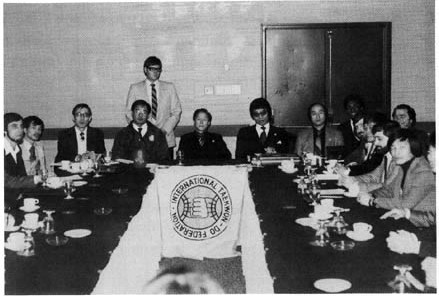
TRAINING SCHEDULE
(Sooryon Gehoek Pyo)
In any undertaking, good planning reduces the risks and increases the probability of success. Well planned programs properly carried out can be likened to catching fish with a net while poorly planned programs can be compared to catching fish with one's bare hands, an obviously inefficient and wasteful exercise.
As training for Taekwon-Do mobilizes the muscles of the entire body, it requires a large amount of energy. A student must move up gradually, from the easy steps to the more difficult, from the basic to the more advanced stages of the development process.
In this manner, the student will not only enhance his health but will develop his techniques thoroughly and consistently. A Taekwon-Do instructor is responsible for the planning of the detailed training schedule for each of his students, particularly the grade holders, so that the programs set for them can be carried out properly and on a timely basis, with students receiving the right amount of instruction in the specified time.
The training schedule ideally should provide a general overview of all of the training programs which in turn are broken into more detailed steps showing the course outline for each class and grade level within a particular program.
The training schedule listed here is a rather broad one. For beginners training for first degree black belt, however, it does present the basic requirement. It is necessary for the instructor to formulate a detailed master training program and lesson plan. This will allow the course to be conducted in a more efficient manner.
There are three rather important rules that should be followed:
- Teach students by rank to avoid unnecessary duplication of exercises by senior students.
- Divide the class into courses for children, adult, and senior citizens. This will enable everyone to practice without fear of either injury or over exertion.
- Rather than allowing the whole class to rest at the same time break the training schedule up so one group is able to rest while watching another group practice.
The group resting should be aligned at the furthest extreme of the practice area and should remain silent while the other group is training. There is a beneficial side effect in this method. The resting group will be able to spot mistakes their classmates are making, thereby correcting their own.
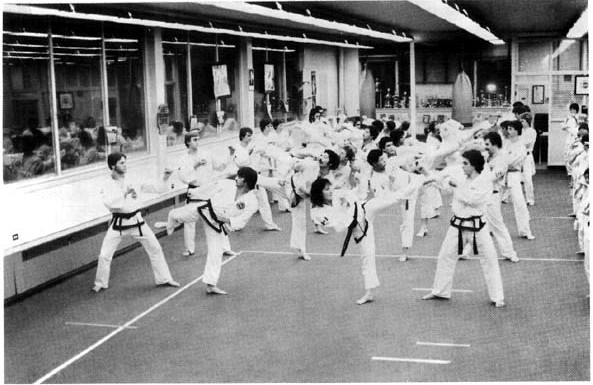
MASTER PROGRAM
| Grade | Fundamental Exercise | Pattern | Sparring | Training Aids | ||
|---|---|---|---|---|---|---|
| 10th | Parallel stance punch | Sitting stance punch | Walking Stance inner forearm obverse block | Four direction punch | 3-step alone | Forging post (with sponge pad) |
| Walking stance spot punch | Walking stance knife-hand low obverse block | Stepping side rising kick | Four direction block | Dyna-strike | ||
| Walking stance forearm low obverse block | Stretchociser | |||||
| Front rising kick | ||||||
| Front snap kick | ||||||
| 9th | L-stance knife-hand guarding block | Walking stance knife-hand low reverse block | Spot turning | CHON-JI | 3-step | Mirror |
| Walking stance stepping punch | Step-turning | L-stance inner forearm block | Stance mould | |||
| Walking stance forearm low reverse block | Side piercing kick | |||||
| Side front snap kick | ||||||
| 8th | L-stance twin forearm block | L-stance knife-hand side strike | Walking stance inner forearm reverse block | DAN-GUN | 3-Step | Pullers |
| Walking stance forearm rising block | ||||||
| 7th | L-stance outer forearm outward block | Walking stance outer forearm wedging block | L-stance back fist side strike | DO-SAN | 3-step | Forging bag |
| Walking stance outer forearm side block | L-stance forearm guarding block | Stepping side rising kick | 2-step | Finger toughner box (with rice) | ||
| Walking stance back fist side strike | Release from a grab | |||||
| 6th | L-stance knife-hand inward strike | Walking stance straight finger-tip thrust | Fixed stance punch | WON-HYO | 2-step | Punching ball |
| Walking stance inner forearm circular block | Stepping side piercing kick | Walking stance reverse punch | 1-step | Forging post (with straw pad) | ||
| 5th | Walking stance palm hooking block | Walking stance front elbow strike | X-stance back fist side-strike | YUL-GOK | 1-step | Blocking apparatus |
| L-stance twin knife-hand block | Walking stance knife-hand rising block | Double side stepping knife-hand side strike | Semi-free | Calisthenics | ||
| Walking stance double forearm block | ||||||
| 4th | L-stance reverse knife-hand block | Walking stance upper elbow strike | Fixed stance u-shape block | JOONG-GUN | Semi-free | Wooden horse |
| Rear foot stance palm upward block | L-stance forearm inward block | Releasing from a grab | Free | Foot raising aid | ||
| Walking stance twin fist upset punch | Walking stance x-fist rising block | Close stance turning punch | Jar | |||
| Walking stance twin fist vertical1) punch | ||||||
| 3rd | Walking stance upset fingertip thrust | Close stance upper elbow strike | L-stance knife-hand low guarding block | TOI-GYE | Semi-free | Improvised training aids |
| Turning kick | Walking stance x-fist pressing block | X-stance x-fist pressing block | Free | Dumbells | ||
| L-stance double forearm pushing block | Walking stance x-fist rising block | |||||
| Walking stance flat fingertip thrust | ||||||
| 2nd | Sitting stance palm pushing block | Vertical stance knife-hand downward strike | L-stance reverse punch | HWA-RANG | Free | Forging pendulum |
| Close stance inner forearm side front block | L-stance side elbow thrust | Self-defence technique | Finger toughener box (with sand) | |||
| 1st | Walking stance knife-hand front strike | L-stance forearm low block | Flying side piercing kick | CHOONG-MOO | Free | Power indicator |
| Sitting stance forearm front block | X-stance knife-hand side strike | Reverse turning kick | Self-defence technique | Holders | ||
| Walking stance palm upward block | ||||||
MASTER PROGRAM FOR 10TH GRADE
| Introduction of Taekwon-Do | Taekwon-Do |
| Practice suit | |
| Reference and others | |
| Nomenclature of the attacking and blocking tools | Forefist, outer forearm, knife-hand, inner forearm, under forearm, back forearm, ball3) of the foot, tibia, outer tibia, inner tibia and side sole |
| Definition of the vital spots | High, middle and low section of the body |
| Reasonable position of the tools for | High, middle and low attack or block |
| Stances | Attention, parallel, walking and sitting stance |
| Fundamental exercises | Theory of power |
| Parallel stance punch | |
| Walking stance spot punch | |
| Stepping motion | |
| Walking stance outer forearm low obverse block | |
| Front rising kick | |
| Four direction punch | |
| Sitting stance punch | |
| Walking stance knife-hand low observe block | |
| Walking stance inner forearm middle obverse side block | |
| Four direction block | |
| Stepping side rising kick |
LESSON PLANS FOR 10TH GRADE
- They can be flexible according to circumstance or individual taste of instructor. - Warming up and warming down exercises must be done before and after training.
1st Week
| Subjects | Reference | Training Aids | |
|---|---|---|---|
| Mon. | How to tie the belt | Taekwon-Do books written by Gen. Choi Hong Hi 4) | |
| Attention stance and bow posture | |||
| Introduction of Taekwon-Do | |||
| Conduct in do jang | |||
| How to fold the do bok | |||
| Tues. | Vital spots and high, middle and low attack or block | ||
| How to make a clenched fist | |||
| Theory of power | |||
| Parallel stance punch | |||
| Wed. | Theory of power | Forging post (sponge pad) | |
| How to punch a forging post stressing the point of focus | Dyna strike | ||
| Principle of stepping | |||
| Walking stance spot punch | |||
| Thurs. | Walking stance spot punch | Stance mould5) | |
| Correction and demonstration | Mirror6) | ||
| Nomenclature of forearms and tibias | |||
| Walking stance forearm low block | |||
| Fri. | Parallel stance punch | ||
| Walking stance spot punch | |||
| Walking stance forearm low block | |||
| Correction and demonstration |
2nd Week
| Subjects | Reference | Training Aids | |
|---|---|---|---|
| Mon. | Tenets of Taekwon-Do | Taekwon-Do books written by Gen. Choi Hong Hi 8) | |
| Walking stance spot punch | |||
| Walking stance forearm low block | |||
| Spot front rising kick | |||
| Tues. | Walking stance spot punch | Foot Raising aid9) | |
| Walking stance forearm low block | |||
| Spot front rising kick | |||
| Correction and demonstration | |||
| Wed. | Parallel stance punch | ||
| Walking stance spot punch | |||
| Walking stance forearm low block | |||
| Four direction punch | |||
| Thurs. | Walking stance spot punch | ||
| Walking stance forearm low block | |||
| Four direction punch | |||
| Sitting stance punch | |||
| Fri. | Sitting stance punch | ||
| Four direction punch | |||
| Correction and demonstration | |||
| Stepping front rising |
3rd Week
| Subjects | Reference | Training Aids | |
|---|---|---|---|
| Mon. | Moral culture | Taekwon-Do books written by Gen. Choi Hong Hi 11) | |
| Sitting stance punch | |||
| Stepping front rising kick | |||
| Four direction punch | |||
| Tues. | Sitting stance punch | Pullers12) | |
| Four direction punch | |||
| Correction and demonstration | |||
| How to make a proper knife-hand | |||
| Walking stance knife-hand low block | |||
| Wed. | Sitting stance punch | ||
| Stepping front rising kick | |||
| Walking stance knife-hand low block | |||
| Correction and demonstration | |||
| Four direction punch | |||
| Thurs. | Sitting stance punch | ||
| Four direction punch | |||
| Walking stance knife-hand low block | |||
| Walking stance inner forearm obverse side block | |||
| Fri. | Four direction punch | ||
| Walking stance knife-hand low block | |||
| Inner forearm obverse side block | |||
| Side rising kick | |||
| Correction and demonstration |
4th Week
| Subjects | Reference | Training Aids | |
|---|---|---|---|
| Mon. | Moral culture | Strechociser | |
| Sitting stance punch | |||
| Stepping side rising kick | |||
| Four direction punch | |||
| Four direction block | |||
| Tues. | Stepping front rising kick | ||
| Stepping side rising kick | |||
| Four direction block | |||
| Correction and demonstration | |||
| Principles of 3-step sparring | |||
| Wed. | Four direction punch | ||
| Stepping side rising kick | |||
| Four direction block | |||
| 3-step sparring | |||
| Thurs. | Sitting stance punch | ||
| Stepping front rising kick | |||
| Four direction punch | |||
| Four direction block | |||
| 3-step sparring | |||
| Fri. | Instruction of test | ||
| Four direction punch | |||
| Four direction block | |||
| 3-step sparring | |||
| Correction and demonstration | |||
| Sat. | Test |
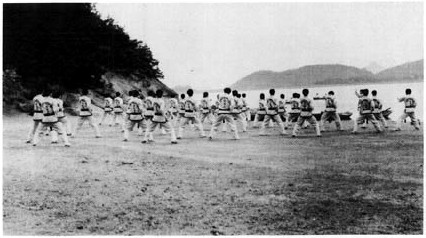
MASS TRAINING SCHEDULE
The following curriculum was adopted by the South Korean Armed Forces, and in May 1968 was presented to the consul International Sports Military Symposium held in Paris 14)by International Taekwon-Do Federation.
One of the great advantages of Taekwon-Do is the ability to train a large mass of students at one single session. This is especially valuable for training military personnel. Mass training is divided into both ordinary and special classes.
1. ORDINARY CLASS.
This is conducted for all men, including officers, and is broken down into the following successive courses.
A. FIRST COURSE15)
This course16) should teach simple basic posture, fundamental movement, and beginner's patterns; CHON-JI and DAN-GUN 17)besides 3-step sparring. Here the student is beginning to toddle and discover the use of his 18)hands and legs for the first time. In two months, the student can be eligible for any grade from 10th to 7th, depending on the mental and physical achievement. This course should take two months.
B. SECOND COURSE19)
This phase of instruction should teach 2-step and 1-step sparring along with DO-SAN and WON-HYO patterns. In this course emphasis is placed 20)on the proper use of the feet. Of course, there is constant repetition of technique learned in the first course. Here the student is walking freely and attempting to run. Upon completion of this course the student can be promoted to any grade from 6th to 5th grade, again depending on his ability.
This course should also take two months.
C. THIRD COURSE21)
In the first half of this course, students learn foot techniques, semi-free sparring and free sparring. The students advance to YUL-GOK and JOON-GUN patterns, and some basic self-defence techniques. In the second half of the course the student is introduced to bayonet drill and practical methods of defense against armed opponents. The adolescent student is now running freely and is qualified to hold any grade from 4th to 3rd. This is another two month course.
2. SPECIAL CLASS.
This class is primarily for training instructors and assistant instructors. The first, second, and third courses are nearly the same as those of the ordinary class with the exception that though the courses are shorter, the daily training is for a longer period.
A. FOURTH COURSE22)
In this course, the students receive more intensive training to develop muscles and sparring techniques. The students begin to practice TOI-GYE and HWA-RANG patterns. Now the student can not only run, but jump as well. Upon completion of this course the students are eligible for 2nd and 1st grade, This course should take three months.
B. FIFTH COURSE23)
This course is a preparatory course for obtaining a black belt. Here the instructor scrutinizes the students and appraises their confidence, leadership ability, moral courage and humility24). Not only is the adult student running and jumping but he also possesses the technique and confidence to participate in any sporting event. Once the student has mastered HWA-RANG and CHOONG-MOO patterns, he may test for 1st degree black belt. This course should take a minimum of three months.
3. TRAINING HALL
An indoor training hall should have a wooden floor so the student can practice barefooted. A wooden floor also offers the flexibility needed to enable students to perform their techniques at an optimum. An outdoor training area is obviously ideal for training a large mass of students, perhaps company size. It should be set up on a level, preferably grassy area. Students are allowed to wear shirts and tennis shoes outdoors.
4. TERMS OF TRAINING
An individual soldier, training one hour per day six days a week, should finish the basic Taekwon-Do training in less than six months. In the advanced phase of the special class, potential instructors must train eight hours per day for an additional six months.