
This is an old revision of the document!
=== THE ORIGINS AND DEVELOPMENT OF MARTIAL ARTS === 1)
Farming, fishing, hunting, medical science, trading and written language are said to have been taught during the reigns of the three mythical emperors Bok Hi, Sin Nong and Hwang Je in China about 3,500 B.C.
On the other hand, the mural paintings in tombs along the Nile and the hieroglyphic inscriptions engraved in the pyramids proved that the Egyptians had a form of open hand fighting similar to boxing as early as 3,000 B.C.
We also have reports of open hand fighting techniques practiced by the warriors of Mesopotamia and Sumer (3,000 B.C.-2,300 B.C.). Then, we can easily imagine that primitive human beings had to depend on their hands and feet to overcome enemies, animals, and the obstacles to survival found in nature.
As human knowledge and wisdom progressed, these crude fighting methods were gradually and continuously improved. Eventually, they were systematized as martial arts.
By the time of the Greek city-states (700 8.C.), boxing, wrestling and other related forms of combat were regular events in the Olympiads. The works of Homer (800-900 B.C.) contains descriptions of unarmed combat, and the Greek philosopher Plato (347-427 B.C.) mentions skiamachia (fighting without an opponent) — a kind of shadow-boxing, which was eventually combined with wrestling and boxing to form pancratium. This was a fighting system in which the whole body was used as a weapon.
The Greek practitioners of pancratium were later transformed into Roman gladiators. The gladiatorial games were ferocious sports performed for the entertainment of spectators during the golden age of the Roman Empire. These games were introduced into Germany, Normandy and England after the fall of Rome and subsequently became the basis of modern boxing and wrestling.
It is recorded that some types of open hand fighting were widely practiced in China at an early date. The art of Palgwae flourished2) during the era of Ju Gong (approximately 200 B.C.) and came to be perfected during the Song Dynasty a thousand years later.
Throughout the world numerous styles of hand and foot fighting have been developed, each of which reflects the needs of the time and the varying historical and cultural background of the country where it originated.
In China open hand fighting is called Kung-Fu or Daeji-Chon; in India Selambam; in France Savate; in Japan, Judo, Karate or Aikido or Jujitsu; in Russia Samba; in Malaysia Bosilat; in Tailand Kick-Boxing; and in Korea it is known as Taek-Kyon, Soo-Bak-Gi, and Taekwon-do.
Some of these forms of self-defence are no doubt as old as mankind itself. It would be virtually impossible to trace hand and foot fighting back to any single beginning.
There are certainly many legends regarding the origins of such weaponless fighting and all too often have some let legend be accepted as truth. There are some authorities who believe that the main impetus of bare hand fighting emerged in China during the sixth century by a renowned Buddhist monk named Bodhidharma (Tamo in Chinese, Daruma in Japanese) the third son of the Indian King Brahman who was known as the 28th Indian patriarch of Buddhist3) Zen.
The essence of Zen or doctrine of Tranquility is to shun material desire, power, greed, vanity and so on through an inward enlightenment.
Daruma (448-529 A.D.) supposedly journeyed from a southern Indian monastery to China via the Himalayas to instruct the Liang Dynasty monarch in the tenets of Buddhism. It is claimed that upon his arrival in China, he went to a monastery called Shaoling Temple located in Shao Shik mountain in 520 A.D.
There he undertook the task of teaching Buddhism to the Chinese monks. They reportedly became physically exhausted from the severe discipline and intense pace that was set by Daruma. To train themselves to accept the harshness of the discipline, Daruma introduced them to a method of mental and physical conditioning outlined in the books I-Jin Kyong (muscle development) and Si Shim Kyong (mind cleaning). These were intended to free them from all conscious control and thus permit them to attain enlightenment. At the same time, supplementing their daily exercise with4) Shih Pa Lo-han (18 movements of Lo-han hands) which imitated the posture of 18 different temple idols.
As a result they supposedly became the most formidable fighters in China.
It is said this method was eventually combined with Shih Pa Lo-han to form the famous Shaoling boxing or Ch’yan Fa (method of Shaoling Fist)
There is little historical data to substantiate this story. Careful scrutiny of the evidence reveals that Daruma arrived in China during the Liang Dynasty of the sixth century. He initially attempted to teach Buddhism to King Moo Je at Kwang Joo but was refused admission to the palace grounds. The missionary then went to small country in the north of China called Ui where he was invited to teach King Myong Je. For reasons that are unknown, Daruma refused the offer and retired to the Shaoling Temple where he remained in meditation and devotion until his death nine years later.
During the period between 1st century B.C. and 7th Century A.D., the Korean peninsula was divided into three Kingdoms; Silla, Koguryo and Baek Je. Silla, the smallest of these kingdoms was constantly under invasion and harassment by its two more powerful northern and western neighbours. During the reign of Chin Heung, Twenty-fourth King of Silla, the young aristocrats and warrior class formed an elite officers corps called Hwa Rangdo.
This warrior corps—in addition to the ordinary training in spear, bow, sword and hook—also trained themselves by practicing mental and physical discipline, and various forms of hand and foot fighting. To harden their bodies, they climbed rugged mountains, swarm the turbulent rivers in the coldest months, and drove themselves unmercifully to prepare for the task of defending their homeland.
To guide themselves and give purpose to their knighthood, they incorporated a five-point code of conduct set forth by their country’s greatest Buddhist monk and scholar Won Kang.
- Be loyal to your king.
- Be obedient to your parents.
- Be honourable to your friends.
- Never retreat in battle.
- Make a just kill.
The Hwa Rangdo became known in the peninsula for their courage and skill in battle, gaining respect from even their bitterest foes.
The strength they derived from their respect to their code enabled them to attain feats of valour that became legendary. Many of these brave young warriors died on fields of battle in the threshold of their youth—as young as fourteen or fifteen years of age.
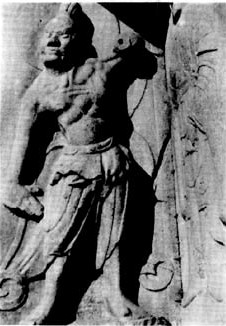 The statue of Kumkang-Yuksa,a famous warrior in Sukulam, a stone cave built in the age of the Silla Dynasty.
Notice the similarities in form between the Kumkang-Yuksa and present day Taekwon-Do.
The appearance of clenched fist, a strong knife-hand, and muscled legs which may have been result of heavy training.
There is much historical evidence to document the existence of a form of hand and foot fighting during this period in both Silla and Koguryo. Some of the postures resemble Taek Kyon or Japanese Jujitsu techniques.
It appears that the warriors of Hwa Rangdo added a new dimension to this primitive method of foot fighting by gearing it to combat and infusing the principles of the Hwa Rangdo. The new mental concept as well as the physical, elevating foot fighting to an art.
During the period of Hwa Rangdo, the original primitive method of hand fighting called Soo Bak-Gi was popular among the common people in the Koguryo Dynasty. The people had a high regard for Soo Bak-Gi. During the Dan-O festivals (on the 5th of May of the lunar calendar) and mid-Autumn festivals (August 15th of the lunar calendar) competitions of Soo Bak-Gi were held along with games of Korean wrestling, tug of war, hopping contests and Jeki-Chagi.
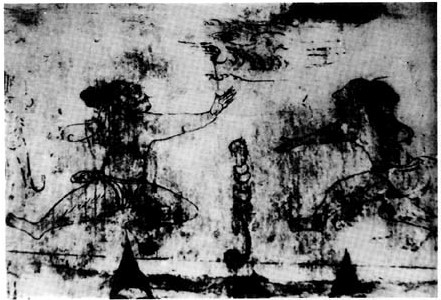
The mural painting at Kak-je Tomb, painted in the age of San-Sang, the tenth king of Koguryo, shows sparring of Soo Bak-Gi. Once again, notice the similarities of these postures and Taekwon-Do flying combatants.
The famous Korean historian, Dr. Danjae Shin Chae Ho, in his writings of ancient Chosun, describes the contests of skill and courage under gruelling5) conditions; “dancing with swords and certain water sports were held on the frozen river to test a contestant's courage and perseverance. Archery and Taek Kyon contests were held to test skill and power.
The winner of the hunt was given the title of Son-Bi. All the above were judged to be necessary prerequisites of the warriors, and the winners were held in esteem by all”. Dr. Danjae states further, that the art of Soo Bak-Gi was eventually introduced to China as Kwon Bup and as a form of Jujitsu to Japan.
While pursuing historical documents relating to the martial arts in Korea, it was interesting to discover that the third king of the Lee6) Dynasty (1401-1408) actively recruited experts in Taek Kyon, Sirum (Korean Wrestling), stone throwing, archery, and Soo Bak-Gi to help in organising a strong army.
Much historical documentation seems to indicate that some of these forms of open hand fighting may have been eventually exported to Japan and formed the basis for Japanese Jujitsu and Karate.
The Korean Hwa Rangdo may have been the forerunners of the famed Japanese samurai. In his book “This is Karate,” Matutatsu Oyama, a well known authority of Karate in Japan, mentions that the etymology of Kara may have been derived from the country of Kaya at the southern tip of the Korean peninsula.