
This is an old revision of the document!
DEMONSTRATION
(sibum)
The purpose of the demonstration is to introduce the dynamic power, skill and graceful movements possessed by the demonstrators. It also assures spectators that anyone, regardless of age or sex, can learn and develop such techniques.
Emphasis should be placed on the following points during the demonstration:
1. The meaning and purpose of each technique should be explained in detail.
2. Some particular self-defence techniques and model sparring should be repeated in slow motion for the spectator to understand both the method and purpose of the movements.
3. Since a Taekwon-Do expert should use this technique reflexly in combat, every technique should be performed in front of the spectators immediately without the benefit of rehearsal.
4. Breaking materials such as boards, bricks or roof tiles should be hard enough that an ordinary person would find it almost impossible to duplicate the student's technique. Breaking with the forehead is absolutely prohibited in Taekwon-Do.
The following is one of the programs presented by a Taekwon-Do team during a tour through Europe, Africa, Middle East and South East countries in 1965.
SAMPLE OF A PROGRAM
| No. Item | |
| 1. Smash one piece of tile with a flying high kick | Demonstrators |
| 2. Fundamental movements | 6th Degree Han Cha Kyo |
| 3. Pattern “Chon-Ji” | 5th Degree Kim Jun Kun |
| 4. Model sparring | 5th Degree Kwon Jai Hwa |
| 5. Smashing 15 pieces of roof tile with the forefist | 5th Degree Park Jong Soo |
| 6. Pattern “Hwa-Rang” | |
| 7. Free sparring | |
| 8. Smash one piece of brick with a knife-hand | |
| 9. Split three pieces of 3-centimeter board with a side kick | |
| 10. Pattern “Ge-Baek” | |
| 11. Free sparring | |
| 12. Smash one piece of roof tile with a footsword while jumping over the shoulders of two standing men | |
| 13. Smash two pieces of roof tile with a flying front and turning kick | |
| 14. Self-defense techniques (Releasing from a grab) | |
| 15. Pattern “Po-Eun” | |
| 16. Foot technique sparring | |
| 17. Split two pieces of 3-centimeter board with a mid-air kick | |
| 18. Free sparring, one student against two opponents | |
| 19. Self-defense techniques | |
| 20. Split two pieces of 3-centimeter board with a turning and reverse turning kick | |
| 21. Self-defense techniques (defense against a bayonet and dagger) | |
| 22. Split one piece of 2-centimeter board with flat fingertips | |
| 23. Pattern “Choi-Yong” | |
| 24. Split two pieces of 3-centimeter board while flying over nine persons | |
| 25. Smash one piece of roof tile, placed on head, with a flying twisting kick | |
| 26. Split two pieces of 3-centimeter board with a back fist | |
| 27. Pattern “UI-Ji” | |
| 28. Smash one piece of roof tile, placed on head, with a flying turning kick | |
| 29. Smash four pieces of roof tile with a punching kick (forefist and foot) | |
| 30. Pattern “Yoo-Sin” | |
| 31. Smash one piece of roof tile while flying over a motorcycle | |
SAMPLES OF BREAKING TECHNIQUES
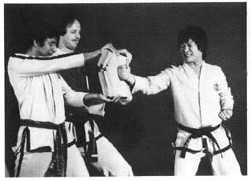
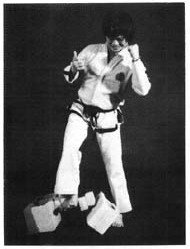
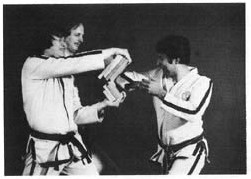
Breaking itself is not Taekwon-Do, as most people misunderstand it to be. The real purpose of destruction in demonstrations is to prove the power of each blow not only to the spectators but to the student as well.
It is both foolish and dishonest to use tricks in breaking techniques. Certainly an unaware audience will be impressed if a stone is broken by supporting one end with the other hand, smashing bricks which are notched or boards that have been narrowed down or dried in an oven. In reality, however, such a demonstrator is only fooling himself.
| Front punch with a forefist | Turning kick with a ball of the foot |
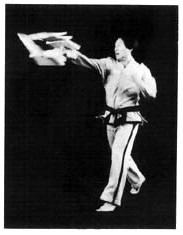 | 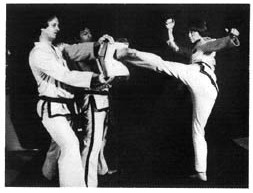 |
| Side piercing kick with a footsword | Reverse turning kick with a backheel |
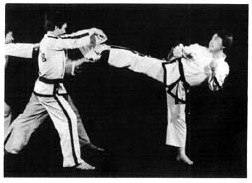 | 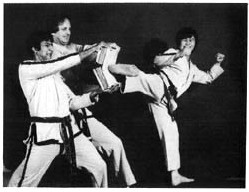 |
| Inward strike with a knife-hand | Inward strike with a reverse knife-hand |
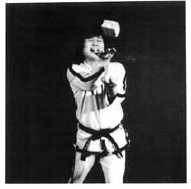 | 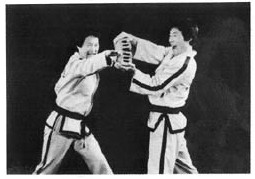 |
| Side front thrust with a flat fingertip | Side front snap kick with a ball of the foot |
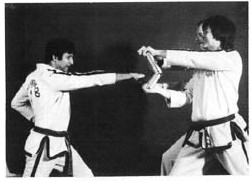 | 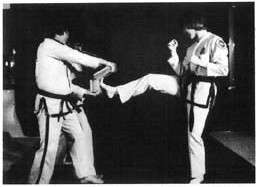 |
| Outward strike with a backfist | Stamping kick with a back sole |
 |  |
| Front strike with a front elbow | |
 |